

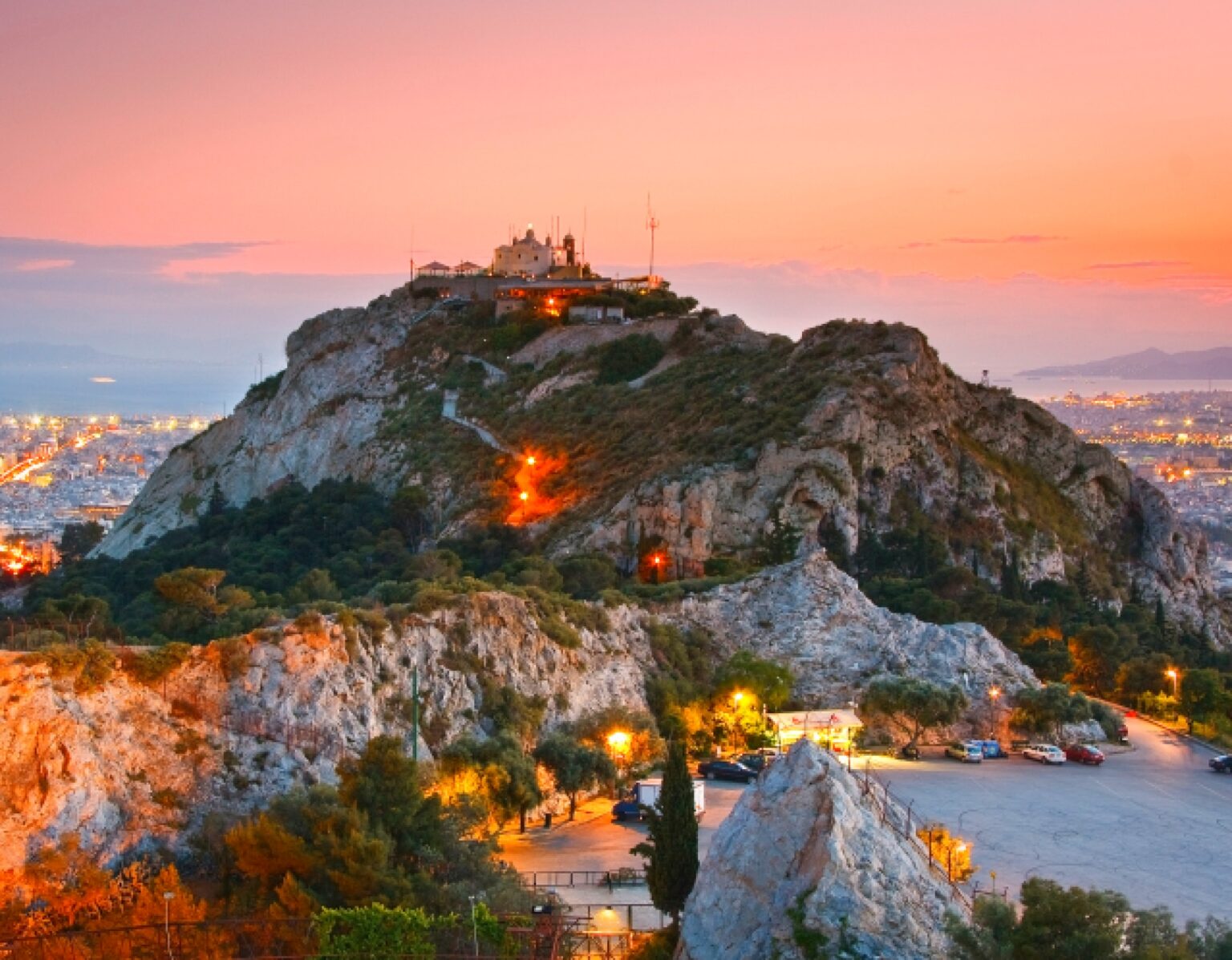
The lofty hill of Lycabettus, which dominates the city, visible due to its height (277m), from almost every point of it, is one of the most beautiful places that Athens has and one of the most characteristic images of the Athenian landscape.It is suitable for nice escapes in nature, for walks with or without company, with or without a dog, for romantic dates, for exercise, for late nights with endless conversations gazing at the lights of the city, for romance, especially at sunset when everything is painted in the colors of the sunset and wrapped by the veil of twilight.
According to mythology, its formation is due to the goddess Athena, when she, returning from Pallini, carrying a rock to use for the fortification of her temple, heard some very unpleasant news brought to her by a crow, which disturbed her so much that the rock left her hands and fell on the spot where Lycabettus is today.It is said that due to the bad omens that were brought to her, the crows got their black color from then on. And Plato, in his description of the most ancient city of Kritias (112) – the Acropolis – had characterized the hill of Lycabettus, together with Pnyka, as the borders of Athens.